Puppyhood Made Easy for New Owners: Teach Your Puppy to Calmly Greet New People!

Is your puppy ready to welcome new guests over the house? With this calm greeting exercise, you’ll teach your puppy to become a well-behaved host!

@smooshy_mooshy

@smooshy_mooshy

Planning on having guests coming over the house sometime in the future? 

Puppies love new people. So much so, they literally jump for joy! But as they age, that behavior can become difficult to manage and troublesome when someone gets pummeled by a 70-pound Labrador puppy!

We’re going to teach you the steps to teach your puppy how to calmly greet a new person that comes to the house. One quick thing to note before you continue: this won’t happen overnight! You will need to build up to this through consistent practice!

Now, here’s how to get your puppy to become an adult dog that remains calm and reserved when meeting people versus jumping up or barking!

WANT PUPPY RAISING AND TRAINING TIPS FROM EXPERT TRAINERS?

The biggest mistake people are guilty of when greeting a puppy: too much energy!

This is hard of course when confronted with an adorable twelve-week-old puppy. Baby voices and enthusiasm are often the default reactions. Our recommendation when meeting new people: prep your guests first! Let them know that you are training your puppy to be calm when people come over and instead of immediately reaching down to greet your puppy, give your puppy a little time to settle. 

In our recent blog about introducing children and puppies, we recommend teaching kids to act like trees! Stay still, calm, and don’t show the puppy high energy. The same goes for guests coming over! If your puppy is excited and jumping, or barking, for example, receiving immediate attention is actually reinforcing that behavior, teaching your puppy that jumping and barking are acceptable. Instruct your guests to approach your puppy in a calm manner, and if your puppy starts to jump or bark at them, instead of reacting towards that behavior, stand straight and remain still or even ignore your puppy until they settle down. At that point, your guest can approach your puppy, helping to reinforce that calmer behavior is acceptable and receives affection. Remember, it can take several minutes for an excited puppy to calm down, so don’t rush the process!

Doorbells and Knocking at the Door

The Puppy Academy student, Cooper!

The Puppy Academy student, Cooper!

We’re going to help you with a simple but effective exercise that you can work on with your puppy. Since you’ll be answering a doorbell or knock when someone comes over, having a partner to help out with this training exercise will be very helpful! If you know you have a guest that day, ask them to help you before they arrive!

Ask your puppy to go to their “Place” and then ask for a “Sit” or “Down”, and “Stay”. If your puppy is still learning their commands, and working on impulse control from jumping off their place, keep your puppy on a leash for this exercise.

You’ll be working on your puppy’s reaction to the doorbell or knocking at the door by managing your own behavior. Instead of immediately getting up to answer the door, pause for a moment. This will help your puppy by seeing you not react to the noise, and remaining calm. It will also reinforce the “Sit” or “Down” and “Stay” commands you’ve given your puppy, and their initial impulse to run to the door. Keep your focus on your puppy, and try to retain their focus on you. If your puppy is remaining on their Place, mark that correct behavior with “Good!” and reward them with food. You may need to bring out high-value rewards for these exercises!

Slowly, while still keeping your energy low, take a few steps toward the door. The goal of this slow progress is to reinforce your puppy’s “Stay” and reward them. When you do finally answer the door, remain with the same level of energy---low and calm. Ask your guest to not immediately greet your puppy, but rather just walk in and ignore your puppy until you say it’s okay to greet them.

Pro tip: If you do have a very enthusiastic puppy that may not be able to hold their “Stay” for very long just yet, use yourself as a barrier between your puppy and the door. In doing so, you can step in to regain your puppy’s focus on you and redirect them onto their “Place”. 

The Calm Greeting

@breadloafkoda

@breadloafkoda

At this point, if your puppy has been calm and focused on you, give them the “Break” release so they can greet your guest. Again, let your guest know to keep their own energy low, pet your puppy on the chest, and even kneel down to pet your puppy to reinforce that jumping up isn’t the reaction you want.

With your puppy on leash and food in hand, let your puppy go up to the guest to greet them. If they do start to jump, revert back to quick food work to get their energy focused away from jumping up on your guest. Ask your puppy to “Come” for food, and go to their “Place” and even “Sit”. Chances are you might have to do this in the beginning a few times so we recommend that you keep your puppy on leash when meeting guests to help you redirect their behavior with leash guidance. 

TEACH YOUR PUPPY TO STOP JUMPING UP! SIGN UP TO RECEIVE OUR PUPPY TRAINING BLOGS AND TIPS EACH WEEK!

Troubleshooting if your puppy starts to get excited!

These are puppies we’re dealing with after all and little hiccups are inevitable when teaching impulse control. If your puppy starts to get excited even if you and your guest are remaining calm, work with your guest to gain your puppy’s focus. Food work helps in this situation. Tell your guest to ask your puppy for a “Sit” or “Down” and maybe even “Place” and use a yummy high-value treat for them to capture your pup’s attention and reward them with it. . What this creates is leadership and working relationship, not just a fun and new playmate.

What to do if you have a high-energy guest!

We all have a family member or friend that just has a lot of high energy and is really looking forward to meeting your new puppy! Chances are they will be the one that your puppy immediately jumps up on for extra affection. First and foremost, think ahead of time! Prep your guest to try and keep their energy level to a minimum if possible when they first come to your home. And if that doesn’t go as planned, which let’s face it, with puppies not everything goes according to plan, don’t correct or try to redirect your puppy.

Not all guest visits will be the right training scenario. If you know that you can’t work with them on the calm greeting exercise, the best thing to do is to keep your puppy in their crate or play pen when someone is coming over. Correcting your puppy won’t teach them but might potentially create a negative correlation between guests arriving and being corrected. And without your puppy’s attention or your guest’s cooperation, redirecting won’t help in this situation. With the crate, you can keep your puppy put while they settle down enough to come out and then greet your guest.

Now that you have a calm greeting exercise to work on, think of which family members or friends to enlist to help you train your puppy the calm greeting! Remember to prepare your guests ahead of time to remain as calm as possible, and ignore your puppy’s excited behaviors. As your puppy begins to get better at staying calmer, start to create more of a challenge to work through by having some higher energy guests come for a visit!

We’d love to know if this helped you! Leave us a comment below. Also, join us live on Instagram @thepuppyacademy for Q&As each Wednesday at 1 pm PT! Ask our trainers anything puppy behavior and training related for free advice!


Check out these blogs related to puppy training and more!

Puppyhood Made Easy for New Owners: Desensitization Training for Puppies!

Puppyhood Made Easy for New Owners: The Dos and Don’ts of Puppies & Kids!

Top 8 Tips to Keep Your Puppy Safe this Summer!

Puppyhood Made Easy for New Owners: Desensitization Training for Puppies!

Creating resilient puppies that can handle the world and all its sounds! Learn how to teach your pup to be comfortable with common household appliances and noises!

The Puppy Academy student, Levi!

The Puppy Academy student, Levi!

What is Desensitization?

It might sound like a very complex term, but basically, desensitization is the practice of getting your puppy used to different noises - household appliances, kids playing, traffic noises, dogs barking, construction, fireworks, thunderstorms, etc.

When you start desensitization training your puppy, you can use basic obedience routines and food rewards to help your puppy work through these challenging and often scary sounds, while building up their level of comfort and confidence. 

Life is unpredictable and sometimes, things can occur that could frighten your puppy. The benefit of desensitization training for puppies is the lower risk of your puppy experiencing an uncertain situation later in life and reacting! Imagine going out with your puppy and something startling happens, thanks to desensitization training, you can regain your puppy’s attention much faster and easier. It will condition your puppy to look to you for guidance and also help them remain calm during those types of incidents. 

JOIN US LIVE, WEDNESDAYS AT 1 PM PT @THEPUPPYACADEMY INSTAGRAM FOR Q&AS WITH OUR PUPPY TRAINERS!

How do you begin to work through these sounds?

The Puppy Academy students practicing outdoor desensitization during their pack walk in Hermosa Beach, CA!

The Puppy Academy students practicing outdoor desensitization during their pack walk in Hermosa Beach, CA!

Luckily, there are plentiful resources on the internet! YouTube search any of the noises that we listed before and you can find plentiful video loops. Also, there are apps available to download on your phone with similar sound loops. Play these sound loops during your puppy’s playtime, or when they are in their crate, or just hanging out with you. The key is that your puppy is listening to these sounds in a calm and controlled environment. You can control the volume of the noises, starting at the lowest setting and gradually increasing to higher levels up to where your puppy tolerates and as your puppy grows more comfortable.

There are two instances we recommend you focus on when it comes to sound desensitization training your puppy. The first, being during downtime. So think of your puppy’s crate or playpen when they are settling in during the day for a rest. Play the loop in the background on low to help them get used to it as part of their normal every day. Then, the second, when your puppy is actively working on an easy and enjoyable training routine, like “Come” for their food bowls. The reason why is because you can’t magically make your puppy not be afraid of something but you can use food to condition to look at you when uncertain situations happen. This builds a positive habit of your puppy relying on you. 

Desensitization to household appliances!

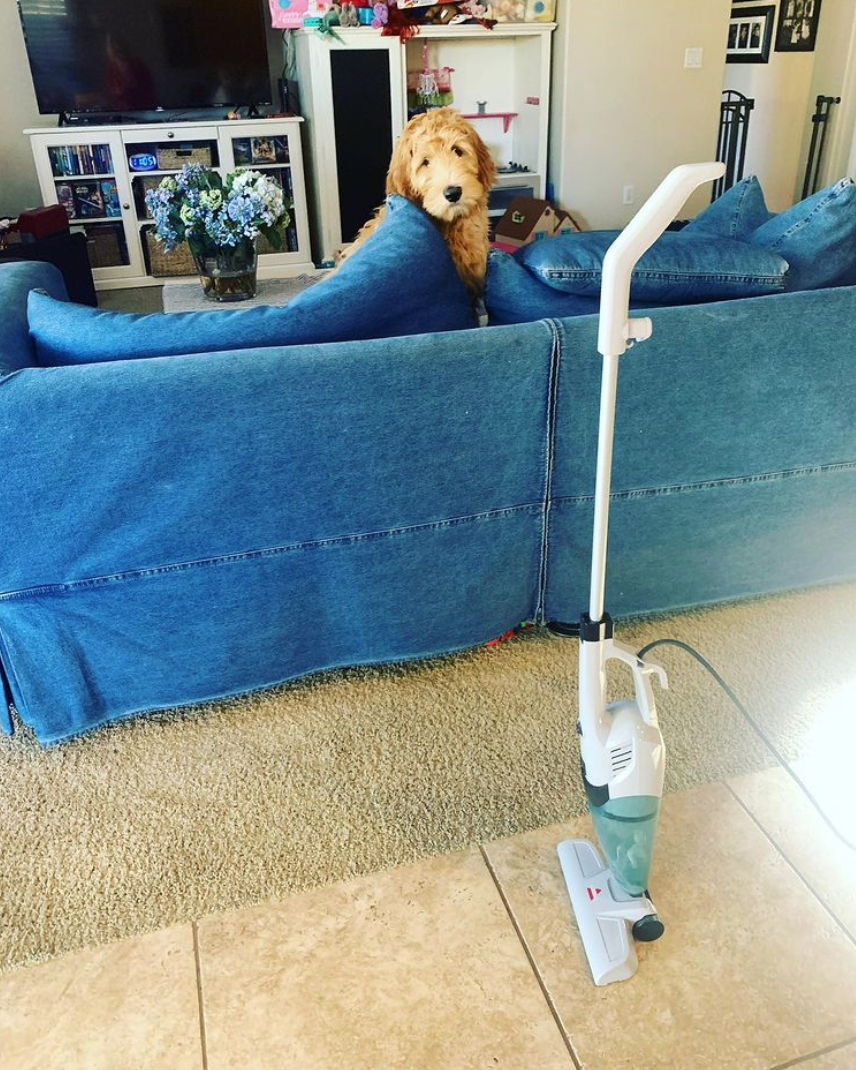
@finleythelabra_doodle

@finleythelabra_doodle

Get ready with plenty of treats! 

The infamous vacuum, hairdryer, blender, or even plastic garbage bags. These regular household appliances and items can stimulate your puppy’s fear drive and send them running under the nearest bed. 

The best method to start to desensitize your puppy to these things is in an organic way. If you plan on vacuuming twice a week, for example, have your puppy nearby and treats ready. While you are actively vacuuming, give your puppy a few treats, let them sniff around, and be near you while you go about your vacuuming. You only need a few minutes of actively working with them to make this an effective session.

What if you don’t have the time to work with your puppy while doing chores? The best-case scenario is to place your puppy somewhere safe, like their crate, away from whatever appliance you are using. While this might seem counter-intuitive, the reason is if you can’t work with your puppy for food, allowing them to get startled and not addressing it, reinforces their fear.

Now, it’s time for some real-life practice!

STRUGGLING WITH YOUR PUPPY NOT LISTENING TO YOU? ASK A PUPPY TRAINER LIVE! EVERY WEDNESDAY AT 1 PM PT ON @THEPUPPYACADEMY INSTAGRAM!

Try out this blowdryer exercise!

  1. Either yourself and another person, or just one works too, hold your puppy and treats in hand.

  2. With your blowdryer in the lowest setting on cool, turn it on away from your puppy, just to give them time to listen to the sound.

  3. If your puppy is calm, or even just curious about the blowdryer, mark that correct behavior with “Good!” and reward with a piece of food.

  4. After a few minutes of just listening, try passing the blowdryer over their back, so they feel the sensation of the air. 

  5. Again, mark the behavior with “good!” and food. If your puppy pulls away from that sensation, go back to just listening for a while, and work up to passing the blowdryer over their fur.

And that’s it! Simple food work like this will help your puppy build resiliency and trust in you. One thing to note, if your puppy does seem nervous during this session, rather than coddling saying “it’s okay”, petting or cuddling your pup but focus on coaching them. Stay calm, reset, mark the correct behaviors, and if you do pet your pup, keep it brief and continue.

Try out this vacuum exercise!

We recommend that you try doing this one with a partner who can either hold your puppy’s leash while the other operates the vacuum.

1. If you are working with a partner, have one of you set up the vacuum near your puppy.

2. Start with your puppy on their place cot, or bed, and have their leash in hand. 

3. Turn your vacuum on and simply let it run for a few seconds.

4. While the vacuum is running, if your puppy is calm, the person holding the puppy’s leash and treats can mark the behavior with “good” and reward them.

5. Continue this exercise for a few minutes during the session. 

While your puppy is getting used to the noise of the vacuum, don’t introduce movement just yet. After a few sessions, start to move the vacuum as you would while cleaning, without it turned on as having it running and moving at the same time might be a sensory overwhelm for your pup! This will help to gradually get your puppy used to the vacuum’s noise, then movement, then the combination of the two at the same time.  

When you do introduce both the sound and movement of the vacuum, try to give your puppy an easy command routine they can follow. A simple “Come” from “Place”, then back to “Place”, for example, will help maintain their focus and energy directed at working instead of potentially getting nervous about the vacuum.

Troubleshooting if your puppy is nervous!

@badu.thedachshund

@badu.thedachshund

There is always a chance that if you have a more nervous puppy, they may not want to work for food because they are focused on the sound. If you are experiencing this, try using a higher value reward. Instead of kibble or their regular treats, you can substitute small bits of chicken as one option!

Also, we often recommend that you opt to do food work before your puppy has had their meal. This way, they will have more of an appetite and you can even utilize this desensitization session as a way to feed your puppy while also working.

If your puppy is still nervous with the sound of the blowdryer or vacuum, keep the appliances near your puppy, turning them on for only a few seconds, and give your puppy something to work on. Pick a routine like “Come” from “Place” and back to “Place” and “Sit”, or something your puppy really knows and enjoys doing to ease the pressure of working with a loud and scary appliance.

How did your puppy’s desensitization training work out? Like a lot of things related to puppy training, desensitizing your puppy to sounds takes consistent repetitions. But you don’t have to do this all your own! Join us each Wednesday at 1 pm PT on @thepuppyacademy Instagram for our LIVE Q&A with our expert trainers. We’ll talk about desensitization techniques you can try with your puppy, plus more useful puppy training tips!

Check out these blogs related to puppy training and more!

Puppyhood Made Easy for New Owners: The Dos and Don’ts of Puppies and Kids!

Top 8 Tips to Keep Your Puppy Safe This Summer!

Puppyhood Made Easy for New Owners: Socializing Your Puppy to Dogs and People!